|



Used under exclusive license to TAIS Performance Systems, Inc.
699 Cardero Street, Suite 502, Vancouver, BC V6G 3H7 Canada
All rights reserved.
| Introduction |
 Welcome
to your TAIS Performance Report.
Welcome
to your TAIS Performance Report.
The Attentional & Interpersonal Style Inventory (TAIS) measures constructs crucial to effective performance, especially performance in high pressure situations. It has been used as an aid for training and selection in business, sport and the military. Organizations like Citibank, General Motors, Harley Davidson, the Navy SEALS, the U.S. Drug Enforcement Agency, the Boston Celtics, and U.S., Canadian, Italian and Australian Olympic teams have all benefited from TAIS.
The usefulness of this report will depend upon how honestly and accurately you have evaluated yourself. With valid results, you will be in a better position to identify performance environments, jobs, and missions that will play to your strengths. Your TAIS results will emphasize how you are likely to react under stressful conditions and will illustrate how pressure affects your ability to concentrate, stay motivated, and communicate effectively. This is precisely the information you need to develop the ultimate performance-enhancement program.
While this report should, in general, validate what you already know about yourself, TAIS information provides a unique opportunity to learn more.
-
More about improving your decision-making
- More about identifying conditions likely to lead to success or failure.
- More about developing mental and interpersonal skills.
How
To Read Your Results
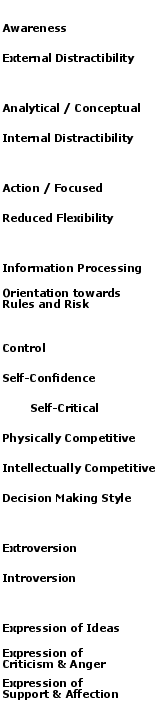
 This Performance Report details your scores on each of the TAIS scales.
The scales measuring Concentration skills appear first, followed by the
Interpersonal Characteristics scales.
This Performance Report details your scores on each of the TAIS scales.
The scales measuring Concentration skills appear first, followed by the
Interpersonal Characteristics scales.
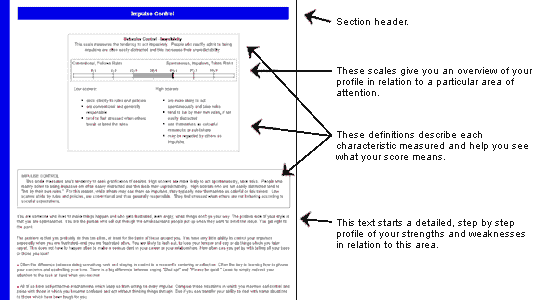
Each section in this report brings together analyses of your tendencies
in related areas. Each section follows the same format, presenting
a summary of your performance before offering detailed explanation and
ACTION POINTS which may help guide your development.
 |
The graphic representation looks like this:
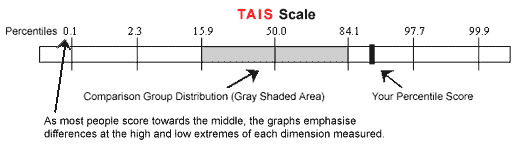 |
TAIS Scores are presented as percentiles ranging from 0.1 to 99.9.
The percentile compares your score to a standard norm group. The
average score on each scale for the standard norms is 50. Your score
is represented as the heavy black line.
Your scores are also compared with a more specific comparison group.
The comparison group scores are represented by the gray shaded area on
the graphic.
In this report, the gray shaded area encompasses 67% of the scores for the TAIS Standard Norm
group. Therefore if your percentile score falls outside the gray
shaded area, you can conclude that you scored significantly different from
"typical" TAIS Standard Norm.
| TAIS Scale Profile |
|
| Attentional Styles |
| ATTENTIONAL SCALES
TAIS inventory is unique in that it incorporates concentration skills along with intra and
interpersonal characteristics in its overall assessment of performance. To concentrate
effectively, you need to be able to shift both the width and direction of your focus of
attention in response to the changing demands of performance situations. The attentional
scales on TAIS measure two things: 1) Your ability to develop the different types
of concentration required to perform effectively, and; 2) Your ability to shift
back and forth between the different channels of concentration at appropriate times.
Because TAIS measures the basic elements of concentration, scores from the inventory
can be used to identify the specific skills individuals need to work on to improve
their performance.
|
|
This scale measures an individual's sensitivity to what is going on in the environment.
|
|
This scale measures how easily an individual can be distracted from what they are doing by external factors, such as noise, interruptions and other activities.
|
|
This scale measures an individual's ability to engage in big-picture analysis, planning, and complex problem-solving.
|
|
This scale measures an individual's tendency to be distracted by irrelevant thoughts and feelings.
|
|
This scale measures an individual's ability to narrowly focus attention on one thing, to discipline one's self, to follow through, and to avoid being distracted.
|
|
This scale measures how likely an individual is to make mistakes because of narrowing attention too much, thereby either not noticing other relevant factors or focusing exclusively on irrelevant thoughts and feelings.
|
ATTENTIONAL OVERVIEW
We need your help in explaining your TAIS inventory
attentional profile. Your profile is highly impressive
and statistically quite rare. In particular, the scores
on all three of your attentional styles (SIGNAL) are
well above those of their corresponding distraction
scores (NOISE -- second member of each attentional
pair). Translation: By your answers you are indicating
that you are keenly aware of your moment-to-moment
surroundings, AND you're able to put ideas together,
anticipate consequences, plan, and devise strategies far
better than most people AND THEN you can turn around and
focus on all the details as you follow through on almost
all that you've sensed and planned. Further, you can
switch from one of these styles to another in the flick
of an eye, and can do this even under high levels of
pressure. Almost everyone you meet is less capable than
you are in these regards.
Sounds great. So what's the problem? Your scores relate
to a person who's like an automobile which is most
powerful, and yet gets the best gas mileage. In reality,
the dragsters that run the quarter-mile in 5 seconds get
horrible gas mileage, while a very fuel-efficient car
might have difficulty getting up to speed on highway
on-ramps. Most cars aren't completely optimized for one
at the utter expense of the other; rather, a trade-off
is made so that both qualities are to some degree more
or less acceptable. And yet, their relative emphasis is
the difference between, say, a Porsche and an Audi, and
between an Audi and a Volkswagen. So, the question is,
does such a best-of-all-worlds kind of person really
describe you?
Consider this: Imagine being in a TV store with 40 sets
showing 40 different television programs. You can choose
to skim all 40 to take in the variety of images, and
judge, say, the varying picture sharpness among them.
But as soon as you try to focus on what's showing on
them, they "compete" for your attention; turn to a news
broadcast on one and you start to lose track of the
ballgame on another, etc. The competing "shows" are our
internal films, the ones we construct in our head. Often
what we can imagine is more interesting than reality.
When we go inside our head, we lose track (at least
temporarily) of our surroundings.
You get the point. Human beings have definite
limitations in the ability to pay attention. Yet we
forget our limitations. We try to talk on the phone
while we listen to someone in our office. Yet no one can
listen to two, brand-new, complex messages at once. So
we must make choices -- choices between being aware of
our surroundings, going inside our head to think, and
following through on details. Human beings are "biased"
(e.g., right- vs. left-handed) in practically everything
we do. For this reason, TAIS inventory reports are
designed around your highEST and lowEST attentional
scores. When you are using one style (tuned into one TV
show), you cannot be using another style (watching
another channel) at just that moment.
In our experience, people score this impressively
because of three different reasons. First, a few people
are generally well above average and handle pressure
extremely well... Superstars. Second, some people are so
optimistic or upbeat that they rarely dwell on their
problems or mistakes. Third, some people so need to
present a good front that they exaggerate strengths and
play down weaknesses whenever they can. If you have been
successful and possess a strong drive to achieve, you
probably are truly quite capable and expect near
perfection from yourself. You hate to admit mistakes
] even to yourself. You may be good, even great, but we
doubt if anyone is truly as capable as your scores. We
might be wrong, but . . .
The major value of taking the TAIS inventory is in
getting an accurate reading on your relative strengths
and relative limitations. There is evidence that most
successful people are realistic in assessing such
matters. There is no "weakness" in admitting the
inevitable -- nobody can pay attention to everything at
once. Because your three attentional scores are all so
high and probably close to each other in percentile
score, you need to look deeper into which one is your
favorite channel and which is your least preferred or
used. Ask those people who know you well which
attentional style they consider your chief asset. This
information is valuable even if you are quite capable of
handling most situations adeptly.
ATTENTIONAL PROFILE
RELATIVE STRENGTHS -- CONCEPTUAL/ANALYTICAL FOLLOWED AND
SUPPORTED BY AWARENESS.
You have indicated that your greatest attentional strength is your ability to analyze
and synthesize input from various sources. This broad-internal focus of attention
enables you to conceptualize relationships among events, plan (business
projections), develop strategies, and anticipate consequences of action. You
adjust quickly to changes in priorities and generating creative approaches to
problems. You like to review and mentally rehearse situations in order to learn
from them and prepare effective responses.
You often take a conceptual approach to events, thinking and planning even when
you are not actively involved. Problem solving exists just for the enjoyment of
creating and figuring out something. Thus, when events do not make sense to you,
you experience frustration.
Your point of pride is, "I FIGURE THINGS OUT, HAVE LOTS OF IDEAS AND
SYNTHESIZE INFORMATION FROM DIVERSE SOURCES."
You have also indicated that you are almost as aware of your surroundings as you
are conceptual. Your ability to read people helps you think on your feet.
The environment probably stimulates many of your ideas.
There are costs to being highly conceptual, too. Under pressure, you are likely to
get caught up in your thoughts and projections and seeking stimulation when you need
to be more focused. Your "street sense" is a fine antidote to your ideational side
in that it keeps you from "paralysis by analysis." You probably do get lost in
thought at times, but apparently not for long. Your decided interest in the big
picture, however, does take you away from the details of your action plans.
COMPENSATING THROUGH STRENGTH. When you figure things out, you know
where to look and what to concentrate on, even if it is only for a
brief time. You are good at making topics significant or interesting.
This makes it easier for you to concentrate on them or monitor them.
Knowing where to look reduces mistakes.
RELATIVE WEAKNESS--FOCUSED CONCENTRATION.
You rarely go in a straight line to anything. Your most common lapse in
concentration is failing to stay with a topic long enough to take care of the details
or complete the work. While you are capable of disciplined concentration, you have
indicated that the focused (narrow) style is your least preferred mode of attention.
Under pressure, you are more easily seduced by the allure of the new idea than by
finishing the existing one. Your big picture approach crowds out the details.
Learn to slow down enough to complete all your sentences. Don't assume that
others will fill in the gaps in your communication the same way you imagine them.
Be careful that you do not overload agenda. Even if you do not overload
yourself, you often confuse others. You listen for the gist of the message,
jumping ahead mentally to other matters. Sensitive observers can tell from the
glazed look in your eyes when you "tune out."
Taking notes can keep you focused.
You will be wise to team with more focused individuals who will keep you
on target and realistic about time management. You tend to think you can do
almost everything as soon as you can think about it or see it in your mind.
You need good habits especially in record-keeping matters.
Team Building. Your ideal pairing is with people who are focused and detail
oriented, people more motivated to finish projects than think of new ones. You
can supply the ideas and establish priorities or big picture.
REDUCED FLEXIBILITY OR INABILITY TO SHIFT FOCUS -- LOW
It's difficult -- no impossible -- to pay attention to everything. All human beings
get distracted or lose control of their attention at least occasionally.
In your case, it's not so much getting distracted which seems to be your biggest
attentional problem as it is your tendency to get stuck on something irrelevant or
counterproductive to the exclusion of what is important. When this happens, you
lose your ability to switch styles and be flexible in meeting complex demands.
You have indicated that you let this problem ruin your performance far less than
the average person does. Still, you are apparently someone who expects near
perfection from yourself. Thus, on those rare occasions when you feel like you
did not do your best under pressure, it really bothers you. They may have been
important times, e.g., in a key negotiation when you pressed too hard.
We all get stuck and lose our flexibility when we get too agitated or emotional.
There are two basic reasons for losing our cool--anger and fear or anxiety.
When you get angry at something a colleague or you yourself do, your attention
rivets on that thing and you lose perspective at least temporarily. If you are
honest, you know you are not at your best when you lose your temper (whether you
show it or not). For example, you might let someone's being late cause you to
steam internally about such an inconsiderate action. When the person arrives,
you are not as capable of dealing with the complex issues that meeting raises.
Fear or anxiety has a way of grabbing hold of us and not letting us go on to other
matters. We lose our flexibility when we let fear or worries take hold. When your
mind gets stuck on that concern (e.g., about whether you can handle the difficult
questions from the board), you fail to concentrate on the things needed for
performing well (e.g., the questions being asked). As you review such incidents,
you probably can discern that you tried too hard with your basic plan long after
it was obvious it was not working.
For more on how to figure out what to do about your most common attentional lapse,
check with the professional giving your this feedback or Enhanced Performance
Systems about Attention Control Training. The professional will help you decide
which of the two forms of stress costs you your flexibility most often and what to
do about it. In general, learning to "say hello AND good-bye to distractions" is
probably one of the quickest ways to improve your performance. As you learn how to
identify quickly when you are frustrated or anxious, center yourself, and redirect
your attention to the task at hand, you will find that your ability to recover from
mistakes will improve. This pattern will be the heart of the stress-management
program you need to perform up to your ability level.
| Preference for Diverse Activities |
| INFORMATION PROCESSING
Jobs differ in the variety of activities they require and the amount of information which persons in them are expected to handle. People differ along this dimension, too. Some are stressed by having too few things to do, others by having too many. People who score high on this scale are indicating that they are "information junkies," liking to juggle many tasks at once. Those who score low on this scale generally prefer to do one thing at a time and are like people in the crafts, doing something nearly perfectly before moving on. This scale measures your preference for diverse activities and the actual number of different events happening in your life. |
|
You like the fast track, the hectic life. You have a lot of energy to take on
multiple tasks.
On the other hand, you show above average need for closure, to follow through,
take care of the details.
These two tendencies are at cross purposes with each other. It is almost
impossible to juggle multiple activities and still give each the care it needs. Thus,
you are likely to feel stressed because you put yourself into many demanding
positions and still demand of yourself the perfectionism of completing each one
well.
Long-term you are a candidate for burnout. You can probably handle this for a
while, but you do it by being organized AND by working long hours. You can
keep this up only so long. Yes, even you.
| Orientation towards Rules & Risk |
| ORIENTATION
TOWARDS RULES & RISK
Measures the probability of strict adherence to a set pattern of thought or behavior. High scorers are more likely to act spontaneously, take risks, and think and act in "out of the ordinary" ways. High scorers who are not easily distracted tend to "live by their own rules." For this reason, while others may see them as impulsive, they typically view themselves as colorful or risk takers. They feel stressed when their patterns of thought or behaviors are confined within predefined boundaries. Low scorers abide by rules and policies, are conventional and thus generally responsible. They feel stressed when others are not behaving according to rules or expectations. |
|
You have indicated that you are highly disciplined in both your behavior and your
ability to pay attention, to stay on task when necessary. Your ability to control
your behavior, to not give in to your impulses very often, is probably crucial to
your performance.
In general, people successful in business are disciplined. There is one major
concern with such a tendency. Sometimes people like you who are so good at
sticking to their knitting, at following through on what they promise, keeping
appointments, etc. find it difficult to understand others who are not so well-
behaved. True, these people do have more fun at times, but do they have to be so
irresponsible? You may not say these things outloud, but you may show (in subtle
ways) your disapproval. Even if they deserve censure, your relationship may
suffer. Perhaps worst of all, many others may consider you as too well-behaved.
They may even call you "stodgy."
You are advised to take a deep breath whenever someone irritates you by
not playing by the rules (your rules?). Is this behavior just a harmless
affectation or is a serious breech of policy or decorum? Make sure that you
can distinguish between these with a clear head before you take action.
Team building. Believe it or not there are times when your well-behaved
approach is not going to work. At times, the situation calls for someone who does
not let rules or policy stop them from doing what needs to be done. Learn to
identify these people and discern those rare times when they should "pull the
trigger" because you will hesitate too long. Let's face it, don't you find yourself
cringing at some of the questions investigative reporters ask.
| Drive and Confidence |
| DRIVE AND CONFIDENCE
The twin towers of dominance are the desire to have control over what happens and the self-confidence to believe one's approach is the right way. These two characteristics are like fire. Fire, properly controlled, fueled progress in early civilizations. Out of control, fire destroys. The drive to succeed and take a leadership role accompanies many -- but not all -- leaders. Similar levels of drive are also found among many people with behavioral problems, even some with criminal records. So much of the direction in which this drive takes one depends on who is the master of the power and how it is applied. CONTROL (of others) Indicates how much individuals like to control others and actually take charge or assumes a leadership position. SELF-CONFIDENCE Measures the extent to which people think they are competent at doing things and how good a person they think they are. SELF-CRITICAL Reflects how critical people are of themselves. Very high scores tend to accompany depression. This scale often reflects temporary problems in the personal or professional lives of participants, and it subtracts from the self-esteem which they are feeling at the time of assessment. |
|
|
|
You have a tremendous drive to be in control or come out on top of challenging
situations. You feel you have to excel at everything which matters to you.
Anything but ultimate success eats at you until you can correct the situation. After
experiencing some frustration about less-than-stellar performance, you bounce
back, eager to try again and sure you will do better the next time. You have the
killer instinct. Such a fire within often accompanies success.
The drive you have poses potential problems between you and those you lead or
work with. Whether yours gets in the way of relationships with others is
influenced by other TAIS inventory dimensions such as whether you are relatively
more supportive than critical and whether you are impulsive and/or easily
distracted.
Issues of control and delegation make or break most organizations and their
leaders. No one can do everything. Leaders need to balance doing it themselves
and delegation. Most driven people have to guard against trying to do everything
themselves. "If you want something done right, do it yourself," is their motto,
spoken aloud or not. Lack of delegation becomes a major problem when there is
the need to develop strong members of the team.
Team Building. Wise and effective leaders balance doing it themselves with
delegation.
Delegation requires precise communication. Be clear about what
responsibilities and authority the person to whom you are delegating has.
A central issue in organizations is the battle over who will be in charge. When two
or more strong-willed people come together there is always the chance of an
authority conflict occurring.
You need to be alert for your frustration or displays of temper which arise
when you do not get your way. Develop ways to step back a moment and
center yourself before getting into fights for control.
Trust in the ability of others and a sense of humor about your needs and
imperfections are crucial to defusing authority impasses.
You need to learn to curb your impatience when working with new people
or facing uncontrollable delays.
Team Building. In order for you to work successfully with others of equal drive
and confidence, the following conditions have to be met:
There needs to be a mutual respect for the abilities of each other.
You have to trust each other.
You need to "divide up the turf." Specify who is responsible for which tasks.
Team Building. If key people around you don't share your drive to succeed, you
may find yourselves drifting apart. Especially if you also are quite narrowly
focused in your attention, disciplined and not easily distracted, your coworkers
and/or spouse may see you as completely insensitive to their needs or to any other
way of doing things.
Seek mutual interests to keep you from drifting apart. Strange as it may
sound to you, not all of life's important events are measured by "keeping
score." There are many activities which are rewarding just for the doing of
them. You don't have to worry about losing your competitiveness when you
really need it by immersing yourself fully in intrinsically-interesting activities.
Listening skills are key to your long-term success. One way in which people like
you show their arrogance is by tuning out others’ point of view even while they are
still speaking. You may think you are still listening, but sensitive observers can tell
when you have gone inside your head to play with your own, more-valuable (to
you), ideas.
It is extremely important that you develop active listening techniques so that
others feel that you have heard them. Learn to paraphrase what the other
person said and check to see if you are correct. You must withhold judgment
while you do this.
Finally, arrogance has a way of leaking out. For some like you, it happens
frequently. Some with your level of confidence are so nice and in need of approval
that they typically keep their negative opinions of others’ skills to themselves—
most of the time. If pushed enough, truly confident people will let it be known
that they don’t consider some others worthy of being in their league on the skills
which define their competence.
Learn to laugh at yourself. Become keenly aware of your own limitations.
Can you say the three things Mark McCormack says are the hardest things to
say? "I don’t know." "I need help." "I was wrong." Judicious and congruent
use of these three phrases can take the sting out of your confidence. People
will admire and trust you rather than secretly hoping for your downfall.
| Ways of Dominating and Competing |
| Entire books could
be written about the way control needs and self-confidence play out in
personal and professional relations. Many variables affect their
use including anger vs. support, impulse control, and attentional preferences
and distractibility (see other sections of your report for your tendencies
on these variables). Foremost allies for control and confidence are
the characteristics of physical orientation or competitiveness and expression
of ideas. They are both included here because a) some people have
not had the chance to compete physically, and b) dominance in business
is more often intellectual than physical.
PHYSICALLY COMPETITIVE people try to dominate in physical ways and are prone to keep score as they have in athletic contests even in other arenas whether appropriate or not. They like challenges. INTELLECTUALLY COMPETITIVE (or expression of ideas) scale indicates how likely people are to express what is on their minds. By talking a great deal, many leaders dominate the thoughts and actions of others. |
|
|
You are driven to dominate the scene whether it be with physical skill or through
expression of your clever ideas. In particular, you have indicated that you are
more expressive of your thoughts and ideas than 85 percent of the general
population and more physically competitive than 65 to 85 percent of people. The
chances are high that you dominate most settings with one or both styles of
competitiveness.
It seems that your competitiveness is more evidence of your drive to succeed.
These two variables add fuel to your "fire within." The question which arises is,
"Who owns the fire?" You have the style of many high-level executives and
entrepreneurs. You also have something in common with many people who get in
trouble in some way with authority, either at work or with the law.
Often there is a fine line between tremendous success and major catastrophes for
people with your style. Check again to see if your need for control and self esteem
are high, which we suspect. If so, it is important that you not have some
tendencies which can let this tremendous drive of yours get out of hand. Are you
an angry, critical person? Check to see your level of expression of anger and
criticism in the last section of this report. If so, do you have at least as great a
tendency to express your support and affection to tone down your tendency to get
argumentative or confrontive when you don’t get your way?
Are you highly impulsive? If so, you are likely to have a hair-trigger temper when
someone crosses you or doesn’t agree with you. This tendency is even worse if
you are easily distracted (see your external and internal distractibility scores).
If you have any of the above tendencies, the advice for dealing with a high drive
given in the prior section is even more needed.
You have simply got to learn the following:
It is not a good idea in the long run to orient completely around dominating
others, whether it is through better, quicker arguments or physically.
You will not develop strong associates if you win at everything from golf, to
who has the best car, to conversations.
You really need to mellow out, i.e., learn to relax a bit (take a centering deep
breath) and let go once in a while. You will not lose your drive by becoming a bit
more selective with it. We have seen fathers literally going all out to beat their
five-year-old children in Monopoly or miniature golf. Lighten up.
Find out if people really respect you or just fear your quick tongue.
| Decision Making Style |
| DECISION MAKING STYLE
This scale provides an indication of the individual's speed of decision making. High scorers make slower decisions, tending to sacrifice speed for the sake of accuracy. People who are cautious often worry about matters. Low scorers make quick decisions and are more likely to err because they end up sacrificing some accuracy for the sake of speed. They tend to become impatient with delays. |
|
You tend to make decisions more quickly than the average person and
about as quickly as most business leaders and top sales people do.
You seem to handle pressure about the same as these people do.
You will be frustrated by bosses, coworkers, or subordinates who are
more cautious than you, who drag matters out and make you wait.
Pause a moment when you start to make others feel rushed to move
or commit before they are ready. Paradoxically, you will get more
out of them (on time) if you don't pressure them.
It is important that you find ways to bring into the open your
need and apparent ability to make decisions fairly quickly. Because
some of your rapid decisions will undoubtedly be in error
occasionally (at least in others' eyes), it is really helpful if
they hear your thought processes used in reaching your conclusion.
When they cannot "see" how you made your decision, your "critics"
are free to presume you were impulsive instead of decisive.
Team Building. Sometimes people who work or live together learn
to laugh with each other at their idiosyncrasies in moments of
stress. Laughter relaxes people, defusing enough of the pressure
so that impatient people can wait more patiently and cautious
individuals can move on, take action somewhat more rapidly.
Because you are relatively low on anxiety, you spend less time than
average caught up in your head worrying about problems. This
enables you to switch your focus of attention fairly quickly to
what is going on around you even when you have been thinking. You
still make concentration errors, but you apparently make fewer
pressure-induced mistakes than most people do.
| Orientation towards Others |
| EXTROVERSION
Measures the extent to which people seek out and enjoy the company of others. High scorers are quite outgoing, like to be the center of attention. Individuals in sales and service occupations tend to score higher on this scale than people who are involved in more technical activities. Low scorers tend to be shy. INTROVERSION Measures your need for personal space and privacy. High scorers indicate an enjoyment of time alone. Low scorers generally become stressed when they have to be alone for any length of time. Because each of these scales is defined in a positive manner, some people legitimately score high or moderately high on both of them. Such people are saying that they like being with other people, AND they like being by themselves. |
|
|
You score higher than 70 to 95% of people on the scale which indicates your need
for involvement with others. You are comfortable being the center of attention
and probably (but not necessarily) provide a great deal of positive support for
others (check the expression of support scale in the next section). You meet
people well, establish rapport fairly quickly. Typically, extroverts are happy in
their major relationships. Chances are you are good at playing peace maker,
willing to compromise in order to smooth over "troubled waters."
To emphasize your gregarious side, your need for time alone is quite low (below
the 15th percentile). To be sure, you occasionally seek solace away from people,
but you do this far less often than most people. Problems may also arise for you
because you have difficulty saying "no" to others, setting limits on your
involvement and commitment. You probably are not willing to risk isolation.
Your definite preference for social interaction can lead to a time management
problem for you. Learn to build in restraints to your taking too many "people
breaks" while doing some task which requires working by yourself for an
extended period of time. You might consider telling all the people you most
enjoy socializing with that you are busy and that the closed door is really your
signal for help. In other words, "please stay away because I am trying to finish
that report which is due tomorrow morning." It really is a compliment to tell
others that you find talking to them too irresistible.
If you also don't like to argue or confront people, you will need to develop
some protective patterns to avoid committing yourself to too many things.
Some people learn to say that they will have to check with their boss,
secretary, or spouse before agreeing to any new request. This gives you time
to prepare a nice way to say no to extra involvements.
Find a good model, someone who maintains cordial relationships yet is able
to set limits on others. Imitate how this person s/he says no, firmly but nicely.
Team Building. You can have problems with significant others who both desire
plenty of involvement with you and yet also have a need for privacy. Given your
pattern of scores it is unlikely that you will ever really understand their need to be
alone especially because it conflicts with your need to socialize and be mutually
supportive.
You probably also tend to hog the spotlight perhaps even without knowing it.
This can be intimidating to those who want to take center stage at times but do not
want to fight you for it, or, more appropriately, try to upstage you, the master of
this.
Some open communication is really crucial in such situations.
| Communication Style |
|
|
|
|
You like to talk, and you are quite friendly and supportive to people around you.
You are much more expressive of your thoughts and your affection than most
people. You are confident that what you have to say is well received by others.
Even though you frequently talk too much, most people like what they hear
because it is positive, even complimentary.
You are extremely open about almost everything except what is irritating you. To
get a visual image of the imbalance in your three forms of expression, take a good
look at the graphs above. They show you are above the 84th percentile on
expression of ideas and expression of support and below the 30th percentile on
expression of anger and criticism.
If you are high on control and competitive needs, it may be a good thing that you
cover up your intense drive with charm and support. Up to a point.
People who seem gregarious and expressive but keep certain things to themselves
(like their anger and criticism) are likely to confuse others especially if they are
dominant or controlling otherwise. You seem uncomfortable with sharing your
anger in a straightforward manner. You may dominate conversations, even
intimidate people by your quick wit and your ability to get your way by persuading
others, but you rarely express what is bothering you cleanly and in a timely
manner. You are quite adept at covering up your concerns with something
positive or reasons why you feel the way you do (rationalizing).
You need to learn to listen, to take a deep breath and allow input from others.
You must find a way to be active in your listening (paraphrase what the other
person said, say things like "uh-huh") to keep your attention on what the others are
saying without drifting off into your own thoughts.
You can be well liked and express what irritates you. Even though you are
generally confident, part of you seems worried that if you express your anger
others may not like you, get into an argument or worse yet, criticize you in return.
Leader (Parent, Teacher) Effectiveness Training teaches people how to express "I-
confrontive" messages. They consist of saying how you feel genuinely to a certain
behavior (not the person him or herself). If you are careful to respond to the
behavior with your real feelings, you can keep relations on a positive note as well
as have your needs met. You generally need to shift into listening gear after
expressing your concerns (see the first recommendation).
Remember that you do get angry, everyone does. Often your rare outbursts hurt
others more because they are so infrequent. This is all the more reason for
learning to express "I-confrontive" messages cleanly instead of bottling things up
inside until you burst. People like you often are not good at expressing anger
genuinely because you do not practice it often.
Team Building. You obviously have only one gap in terms of your
expressiveness. Thus, you need a teammate who can help you express what is
wrong with a proposal in no uncertain terms when you are tempted to cover up
your displeasure with a lot of words and charm. Think back on occasions when
(for all your confidence) you let some problem go unattended. Wouldn't you love
to replay that scene with a more hard-nosed partner? Arrange it now so you will
be prepared for the next time.
| Conclusions & Recommendations |
No psychological test or performance measurement is perfect. There may be one or more hypotheses in your TAIS Performance Report that you do not agree with or view as inaccurate. Here is how EPS recommends you deal with those:
- Ask others who are familiar with your performance if they have ever noticed you making those types of mistakes
- Consider that you may have been vulnerable to making those types of mistakes at one point in your life, but have developed compensatory mechanisms
- Do not consider the vulnerability a high priority for intervention
- Thoroughly catalogue your strengths and try to put yourself in performance environments that play to those strengths
- Understand and seek to be aware of your vulnerabilities under pressure and endeavor to keep those vulnerabilities from interfering with performance
- Select 2 or 3 of the vulnerabilities listed in your TAIS Performance Report as targets for your performance enhancement program
- Use the recommendations contained in the Report in addition to other performance enhancement products available from EPS
Good Luck
Index:
|
Used under exclusive license to TAIS Performance Systems, Inc.
699 Cardero Street, Suite 502, Vancouver, BC V6G 3H7 Canada
All rights reserved.
| Recommended Printing Options |
For the best print of this document we recommend that your print margins be set to 1" and that you print the background. To print the background follow these simple instructions for your particular browser:
Netscape:
- Select "File" and then "Page Setup" from the menu at the top of the screen.
- If the box next to the option "Print backgrounds" does not contain a check mark, click on the box.
- Click "OK".
- Select "View" and then "Internet Options" from the menu at the top of the screen.
- Click on the tab labeled, "Advanced."
- Scroll about 2/3rds down until you see "Print background colors and images"
- If the box next to this option does not contain a check mark, click on the box.
- Click "OK".
| How to Save This Document |
When saving a web page to your computer most browsers will not save the images with the page. Therefore, we recommend that you bookmark this page for future reference. To do this follow these simple instructions for your particular browser:
Netscape:
- Select "Bookmark" and then "Add
Bookmark" from the menu at the top of the screen.
- Select "Favorites" and then "Add to Favorites" from the menu at the top of the screen.
- For the question, "Would you also like to subscribe to this page?", respond by clicking the option, "No, just add the page to my favorites."
- Click "OK".